By Jim Blackstock
When the beloved Irwin Block building was lost to fire in 2023, the impact reached beyond the building itself. The loss left behind a desolate empty lot and affected the neighboring Evening Republican building, changing the character of this prominent downtown corner. For a time, the site sat vacant. Roughly two years later, Exhibit Columbus used the site for an installation called Elipsis; a temporary intervention that introduced shade, planting, and a new sense of activity to the space, demonstrating how even a difficult site could become a distinctive public environment.
Soon after, attention turned toward activating the building next door. As the city began identifying opportunities to bring inactive downtown spaces back into use, another related project was already taking shape.
Serendipitously, the Office of Downtown Development recently hired Louis Joyner Architect to conduct research into a noteworthy downtown revitalization effort from the 1960s. At the time, downtown Columbus was a patchwork of buildings in varying states of disrepair. During a 1963 visit to Columbus, designer Alexander Girard observed that many of the city’s handsome Victorian storefronts were being covered with modern glass, altered through haphazard renovations, and stripped of their original character. Their architectural detailing had been obscured by what Girard described as “horrible colors” and a “jungle of signs” that no one could read.
Girard believed downtown could be renewed not by erasing its historic fabric, but by drawing attention back to it. His vision was to use joyful, vivacious color to highlight the beautiful architectural details that were already there, rather than cover them up. That idea became the foundation of an ambitious project centered on reviving what existed. Girard developed a color scheme for each building and communicated his proposals through a series of scaled maquettes that captured downtown Columbus and its distinctive character. Of the many buildings that were painted with Girard’s color palette, only three retain their original color schemes.
While a few of the original maquettes remain at City Hall, many have been lost to history. Working as design detectives, Louis Joyner and his team tracked down images of most of the original models, documented early sketches, scraped through decades of paint samples from several buildings, and combed through old correspondence, newspaper articles, and magazines. Their research helped identify Girard’s original palette and created a resource for building owners who may want to replicate it—or simply use it as inspiration for future improvements.
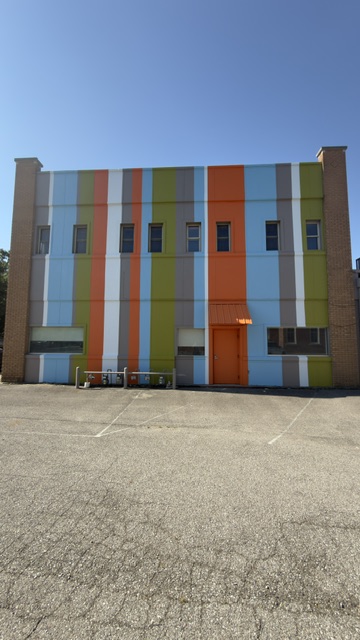
In response to the recommendation of AP-02, Activate Existing Inactive Public Spaces, a grant was awarded to paint the rear façade of the Evening Republic building with Girard’s trademark stripes, using a selection of his most frequently used original colors. Picnic benches were added, along with space for food trucks to serve the area, creating a more welcoming and usable public space at a highly visible downtown corner.
The entire process is a remarkable example of how many different stakeholders can work together over time to lift up and celebrate a beloved site. What began with the loss of the Irwin Block has become an opportunity to reconnect the area to Columbus’ design history, activate an underused space, and prepare this important corner for its next chapter.